Tuesday, April 17, 2007

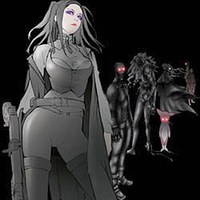
Eden - It's an Endless World! (manga)


[ serialized in [Afternoon] ]
Age rating: Mature (May contain sex, drugs, and extreme graphic violence)
Genres: Science Fiction
Plot Summary: In the panic surrounding a worldwide pandemic which kills 15 percent of the population and cripples many more, a secret organization, the Propater, topples the UN and seizes control of much of the world. A boy and a girl, raised in an abandoned virology research center, immune to the virus, use a powerful combat robot to wipe out the Propater forces who come to retake the island, led by the boy's father. 20 years later the boy is the most powerful drug lord in south america. He aids his son from behind the scenes as he evades and eventually with the help of mercenaries from Nomad (some of them former Propater operatives) fights the Propater. Based strongly on Gnostic mythology, all major characters are named after gnostic deities, and have analogous roles.
Sources:http://www.animenewsnetwork.com/encyclopedia/manga.php?id=2157

Eden: It's an Endless World! is a manga by Hiroki Endo (遠藤浩輝), published monthly in the magazine Afternoon. Eden is set in the near future, following a pandemic which killed 15 percent of the world's population, crippled or disfigured many more, and upset the world's political balance greatly.

Eden is to some extent based on Gnostic mythology, with few characters being named after Gnostic characters, but the range of this influence is difficult to determine.


Plot

Spoiler warning: Plot and/or ending details follow.

The series begins with Ennoea and Hana living a peaceful life on a remote island called Eden, with researcher Lane Morris, who is their guardian, a victim of the pandemic, and a homosexual. The events that led to this situation are revealed in flashbacks, leading up to the return of Ennoea's father, along with the forces of the Propater.

Later on the series focuses on Ennoea's son, Elijah, and his conflict with the Propater.

Characters

Elijah Ballard – The main protagonist, Elijah is introduced on the run from the Propater. He encounters some mercenaries also eluding the Propater and is forced to join them. During his flight he is forced to become a hardened killer.

Ennoea Ballard – Elijah's father, raised on Eden. After he and Hana left there, Ennoea became the most powerful drug lord in South America, and a staunch opponent of the Propater

Hana Mayor – Elijah's mother, raised on Eden. She and Elijah's sister were captured by the Propater while trying to leave Ennoea with Elijah. A major focus of the series is Elijah's quest to rescue his family.

Colonel Khan – The Colonel is an old soldier from Azerbaijan, and the leader of the Nomad group (including Kenji and Sophia) fleeing the Propater at the start of the series. Khan became Kenji's mentor after killing his brother.

Sophia – A powerful Greek computer hacker, and full-body cyborg. Sophia has the appearance of a young girl, but is probably around 50 - 60 years old. Sophia is sort of a mother figure to many characters in the series, most notably Kenji, although her relationship with him is a little more complicated. Sophia was very promiscuous in her youth, and had six children. Her first, whom she tried to kill, and who still bears the scars, is a high ranking member of Nomad. Her last was killed in their flight from Propater, and with his corpse was hidden the disc containing Maya. Sophia later helps to activate Maya.

Maya – An almost godlike AI, which seems to roughly correspond to the savior of Gnostic mythology.

Kenji – The brother of a low-level Yakuza boss, Kenji is extremely skilled at hand-to-hand combat. Kenji is even able to go hand-to-hand with the Aeons. While he initially appears to be a sociopath, killing both soldiers and non-combatants without any signs of remorse, flashbacks in the forth volume show him to be a psychologically complex character who is driven by basic human needs such as love and meaning.

Cherubim – A sophisticated robot built to protect the research facility on Eden, who was later used to destroy it. Cherubim later serves as Elijah's protector, and is a powerful combatant in his conflicts with the Propater. However, Cherubim is not always able to distinguish friend from foe, and often causes collateral damage. Cherubim is named after a type of angel.

Aeons – Named after a sort of second-order deity in Gnostic mythology, the Aeons are nearly invincible, virtually immortal super-soldiers, designed by the Propater and used by them fairly frequently. The Aeons have arms which are segmented and extensible, and are armed with sharp claws. They will flail them around like whips, and they can also shoot their claws as projectiles. They can be killed, but will not die naturally. They do not seem to have much intelligence of their own. Some high-level Propater agents are also equipped with similar bodies to those of the Aeons.

The Propater – A supranational organization which grew within NATO and the UN, and eventually took them over. The Propater controls much of the world, including Japan, the USA, much of Europe and South America, and its territory is known as "Gnostia." Territory outside the Propater's control is called "Agnostia," and includes most of the Islamic world, and Peru, among other areas. The name Propater is taken from the Latin name of the God the Father in the Holy Trinity and the symbol of the organization, seen on the armor of its military forces, is a cross with a snake wrapped around it.

NOMAD – An international mercenary organization which apparently has goals of its own, which run counter to the Propater. It includes Kenji, Sophia, Khan, and it aids Elijah on several occasions.

Sources: http://en.wikipedia.org/wiki/Eden_%28manga%29
My inspiration:
As the plot summary, this manga reflex a lot to the story in Holy Bible. however, to me, the later part of this manga remind me of the novel The Godfather with many setting related to underground dealing. The content and the drawing is so good make this is a must read manga.


Neon Genesis Evangelion (TV)


Age rating: Teenagers (May contain bloody violence, bad language, nudity)
Genres: Drama, Mecha, Military, Psychological, Science fiction, Shounen

Plot Summary: At the age of 14 Shinji Ikari is summoned by his father to the city of Neo Tokyo-3 after several years of separation. There he unwillingly accepts the task of becoming the pilot of a giant biological humanoid by the name EVA01 and protect the world from the enigmatic invaders known as angels. Even though he repeatedly questions why he has accepted this mission from his estranged and cold father, his doing so helps him to gradually accept himself. But why exactly are the angels attacking and what are his father’s true intentions.
Sources:http://www.animenewsnetwork.com/encyclopedia/anime.php?id=49

Plot

Evangelion's plot superficially revolves around the struggles by the paramilitary organization NERV to prevent the city of Tokyo-3 and the Geofront underneath it from being destroyed by monstrous beings called Angels. To this end, NERV enlists three teenagers, Shinji Ikari (the son of NERV's commander Gendo Ikari), Rei Ayanami, and Asuka Langley Soryu, to pilot enormous mecha called Evangelions into battle against the Angels. As the series progresses, it is revealed that the true purpose of NERV, the Evas, and the Angels is to bring about a forced evolution of humanity with potentially cataclysmic repercussions. The struggles of the central characters to overcome their personal issues and personality conflicts factor heavily into the events of the series, and become integral to its conclusion. Towards the end, psychological issues predominate and the apocalyptic events in the real world are only alluded to "over a montage of bleak visuals, that include black and white photos of desolate urban motifs such as a riderless bicycle or vacant park benches interspersed with graphic stills of the devastated NERV headquarters in which Shinji's colleagues are seen as bloodstained bodies."[12]

The final two episodes were possibly the most controversial segments of a controversial series,[13] although Anno defended the artistic integrity of the finale[14].

Characters

The characters of Evangelion are continuously struggling with their interpersonal relationships, their inner demons, and traumatic events in their pasts, creating a complex pattern of relationships.

The main characters of Neon Genesis Evangelion

Anno described the hero, Shinji Ikari, as a boy who "shrinks from human contact," and has "convinced himself that he is a completely unnecessary person, so much so that he cannot even commit suicide." He describes Shinji and Misato Katsuragi as "extremely afraid of being hurt" and "unsuitable — lacking the positive attitude — for what people call heroes of an adventure;[8] as compared to a typical hero of anime, Shinji is characterized more by lack of energy and emotional affect than any sort of heroism or bravery[15] Rei Ayanami and Asuka Langley Soryu, the other major protagonists, have similar flaws and difficulty relating to other people.

According to Anno, Evangelion was an attempt to make all perspectives into one, creating characters that represent different things to different viewers to make it impossible for everyone to arrive at a single theory. To some viewers, the characters are psychological representations, while to others, they are philosophical, religious or even historical.[16] It seems the main goal was to present characters who reflected the deep depression and eventual recovery that Anno experienced before beginning work on Evangelion.[8][17] Assistant Director Kazuya Tsurumaki said of the series, "If a person who can already live and communicate normally watches it, they won't learn anything."[18]

The character designs by Yoshiyuki Sadamoto have also contributed to the popularity of Evangelion. The attractive designs of the three main female leads, Asuka, Rei and Misato, led to extremely high sales of merchandise[19] (especially of Rei, the "Premium Girl"[20]), and they have been immortalized in the dōjinshi community,[21] garage kit models, and in subsequent anime (such as Burst Angel)

Sources:http://en.wikipedia.org/wiki/Evangelion#_note-2

My inspiration:

This is a great anime both in its plot and meaning. The anime reflex story in Bible and considers heavily on psychology. Even the name of this anime reflex its content which is the most attraction to me: Evangelion = Eva (The first woman in the world) + Angel ( represent for happiness and purity) + Lion (Brave and proud). In my opinion. This is a must see anime for everyone who research or interested in anime

.

Monday, April 2, 2007

My second Business card with the image original made by Subterfuge Malaises on www.deviantart.com. I resized and put a filter on this image.

My first Business card as instruction of the slide show

Monday, March 26, 2007


Digimortal (manga)


Digimortal is a one-shot
cyberpunk
manga by Tsutomu Nihei which incorporates some steampunk overtones. Digimortal, A mysterious armored mercenary on salary to a secret organization, contracts to kill one of the leaders of a new technocratic
Inquisition that is terrorizing the public.

Source: http://en.wikipedia.org/wiki/Digimortal_%28manga%29

My inspiration:

Like Blame!, Digimotal has an extremely dark theme which brings a desperate feeling about a chaotic world where people struggle to be alive. The drawing style bring me a new look at manga and it's content.

You can find this oneshot at : http://mu.devserver.org/index.php?dir=Oneshots/


Blame!


BLAME! (ブラム!, buramu!) is a ten-volume science fiction
manga by Tsutomu Nihei. A series of 6 short OVA episodes were produced based on the series.

The tagline for this manga is "Adventure-seeker Killy in the Cyber Dungeon quest!" or "Maybe on Earth, Maybe in the Future". There is some debate over the meaning of the title, which may be a mistranslation of the onomatopoeia "blam."

Basic plot

Killy, a silent loner possessing an incredibly powerful weapon known as a Gravitational Beam Emitter, wanders a vast technological world known as the Megastructure. He is searching for Net Terminal Genes, a (possibly) extinct genetic marker that allows humans access to the Netsphere. The Megastructure is an endless vertical space of walls, stairways and caverns, inhabited by scattered human and transhuman tribes as well as hostile cyborgs known as Silicon Creatures. The Net Terminal Genes appear to be the key to halting the unhindered, chaotic expansion of the Megastructure, as well as a way of stopping the murderous horde known as the Safeguard from destroying all humanity.

Along the way, Killy meets and joins forces with a resourceful engineer named Cibo and a tribe of human warriors called the Electro-Fishers. They are pursued by the Safeguard, who view any human without Net Terminal Genes as a threat to be extinguished on sight.

Style

BLAME! features extremely dark, highly detailed depictions of the fantastic, ever-changing world of the Megastructure, punctuated by brutal combat. There is generally little dialogue to support the action or story, and the reader is left to piece together the plot for themselves. Many scenes are spent on the long, lonely travels through the Megastructure.

The Megastructure

The Megastructure is actually a structure that began on Earth. The mechanical beings known as Builders, which move around reforming and creating new landscapes, appear to have begun building without end, creating an enormous structure with little internal logic or coherence. The Megastructure, and the Builders, were controlled by the Netsphere and the Authority but they have since lost the power to control the expansion of the Megastructure due to the chaotic and insecure manner of its growth. Without intervention by a user with Net Terminal Genes they cannot reestablish control over the Megastructure nor the Safeguards, whose original job was to eliminate any humans who try to access the Netsphere without Net Terminal Genes. The Safeguard now attempts to destroy ALL humans without the Net Terminal Gene as the degradation of the Megastructure has corrupted their true goals.

It has been suggested by Tsutomu Nihei himself in his artbook Blame! And So On that the Megastructure is actually a growing Dyson sphere of gargantuan proportions. Its spherical circumference is speculated to be roughly the size of Jupiter's planetary orbit (32.675 AU)[1]]. No evidence contradicts this speculation, and the prequel to BLAME!, NOiSE, even states that the structure has passed the orbit of the moon.[2]

Main characters

Main article: BLAME! characters and structures

Killy (霧亥, Killy?)

The main character. He is on a journey to find a human with Net Terminal Genes to access the Netsphere. He is equipped with the Gravitational Beam Emitter, a small but incredibly powerful weapon capable of destruction on a massive scale.

Killy's origin and motives are unknown. He speaks little and rarely hesitates to fight. He has shown superhuman levels of endurance and strength, and appears to be able to heal extremely rapidly. Usually, however, he relies on his GBE to dispatch the opposition. Killy appears to be linked in some fashion to the villainous Safeguard, but exactly how is uncertain. It has been suggested that Killy is an early if not prototype version of the safeguards seen in the manga.

Cibo (シボ, Cibo?) (also addressed as Cibo Shuninkagakusha (シボ主任科学者, Cibo Shuninkagakusha?), "Chief Scientist Cibo")

Head scientist of a corporation in the Capitol. She tries to access the Net Sphere with an artificially created version of Net Terminal Genes, but the experiment fails with disastrous results and summons the Safeguard, leading to the destruction of the entire facility.

During their journey, Cibo undergoes many changes of bodily form, emphasizing the transhuman nature of life in the Megasphere. Cibo cracks security systems and gathers information to help her and Killy's journey. She speaks rather more than the taciturn Killy, often serving to advance the plot.

Sanakan

A high level agent of the Safeguard who first appears as a short, young girl with black hair. She appears to have a particular interest in wiping out the human tribe of Electro-Fishers, and seems to know Killy from the past.

Source: http://en.wikipedia.org/wiki/BLAME%21

My inspiration:

The color which is extremely dark in this manga brings the felling of thriller, terror and sad. Also with little dialogue, this manga brings a strange felling about the world in the future when people must fight for survival.

Monday, March 19, 2007


Ergo Proxy (TV)


Alternative title:

エルゴプラクシー (Japanese)

Age rating: Teenagers (May contain bloody violence, bad language, nudity)

Genres: Adventure, Drama, Horror, Mystery, Psychological, Science Fiction, Supernatural

Plot Summary: In a future where the world has been ravaged by a nuclear apocalypse, there exists salvation in a domed city named "Romdeau", where humans and their android servants, the autoreivs, live in. Under the implementation of complete management control, it is a paradise where feelings are literally discarded, and the governing council dictates the way of life the citizens should live. But this utopian landscape is soon broken by a series of mystifying murders. Real Mayar, a female inspector from the Citizen Information Bureau, along with her autoreiv partner Iggy, are tasked to solve the murder cases. She is soon attacked by a creature drawn to her which is neither human nor android, and learns about the mysterious phenomena called "Awakening", an event which draws her further into the case...and to the world beyond the limits of Romdeau.

Source: http://www.animenewsnetwork.com/encyclopedia/anime.php?id=5115

Setting: The story initially takes place in a futuristic dome city called Romdo, built to protect its citizens after a global environmental apocalypse. In this utopia, humans and androids (AutoReivs) coexist with each other peacefully under a total management system. A series of murders committed by berserk robots infected with the Cogito virus are starting to jeopardize the delicate balance of the social order. Behind the scenes, the government is conducting secret experiments on a mysterious humanoid life form called Proxy, which is believed to hold the key to the survival of mankind.

Trivia

  • The following characters are all named after French Post-structuralist philosophers: Husserl, Kristeva, Derrida, Lacan, Berkeley, Deleuze and Guattari.
  • The character Pino and her name is thought to be a play-on of Pinocchio, there are also some similarities to her and the story of Pinocchio specifically the becoming a real person idea. It also pays homage to Pinoco from the manga Blackjack. Pino's character was partially inspired by Pinoco.
  • Episode 1 begins with a quotation from Michelangelo's reply to Giovan Battista Strozzi's epigram [2] for the Night Stature in the Medici Chapel. The opening sequence from Episode 3 onwards features fragments of this quotation in Italian as part of the background graphics montage.


Caro m' è 'l sonno, e più l'esser di sasso,

Welcome is sleep, more welcome the sleep of stone.


Mentre che 'l danno e la vergogna dura:

Whilst crime and shame continue in the land;

Non veder, non sentir, m' è gran ventura;

My happy fortune, not to see or hear;

Però non mi destar, deh! parla basso

Waken me not - in mercy, whisper low.

—Michelangelo Buonarotti


  • In Episode 1, when Vincent is pouring milk into his alphabet cereal, the letters float up in such a way to spell "Awakening".
  • The Cogito Virus refers to Descartes' "Cogito ergo sum," which means "I think, therefore I am."
  • Inside Regent Donov Mayer's chamber, the stature of two reclining figures on the right is based on Michelangelo's Night and Day stature placed above Giuliano di Piero de' Medici's sarcophagus in Medici Chapel, Florence. In the show, the female figure (Night) represents the voice of Lacan and the male figure (Day) the voice of Husserl. The stature on the left is based on Michelangelo's Twilight and Dawn stature placed above the sarcophagus of Giuliano di Lorenzo de' Medici in Medici Chapel. In the show, the female figure (Dawn) represents the voice of Derrida and the male figure (Twilight) the voice of Berkeley.
  • The robots (AutoReivs) in the show are installed with a Turing Application program that can be switched on and off, allowing normal human-like conversation between humans and robots. This is named after Alan Turing, who proposed the Turing test as a test of AI sentience.
  • In Episode 2, the baby carriage falling down the stairs during the Central Mall massacre is reminiscent of the Union Station shootout scene in the film The Untouchables, which is itself a reference to the Odessa Steps scene in The Battleship Potemkin.
  • Episode 3's title is taken from the title of a science fiction novel "Прыжок в ничто" (Leap into the Void) by Alexander Beliaev.
  • During the intro theme song, after the head of the kneeling AutoReiv is seen, there is a short sequence showing an electron-microscope image of the Ebola virus.
  • In Episode 3, Re-l Mayer's ID Card No. is re-l124C41+ (homage to Hugo Gernsback's Ralph 124C 41+), a word play - Real one to foresee for one.
  • In Episode 4, the character Hoody is reading poetry by Joë Bousquet, a 20th century French surrealist poet who later had enormous influence on Gilles Deleuze. Also at the beginning of the episode Vincent is pouring milk into his alphabet cereal, the letters float up in such a way to spell "Misfit". "Misfit" meaning one who is unable to adjust to one's environment or circumstances or is considered to be disturbingly different from others.
  • In Episode 5, Hoody mentions a boat called the Centzon Totochtin, named after the group of 400 rabbit-deities from Aztec mythology.
  • In Episode 7, the Amrita immortal cell line is named after Amrita, the immortal drink in Hindu/Buddhist mythology.
  • In Episode 8, base commander Patecatl, first officer Omacatl and the female prisoner referred to as Mayahuel in the end credits are named after Aztec gods. This episode also features a number of Alice's Adventures in Wonderland references, including two of John Tenniel's illustrations (Gardeners Two, Five and Seven, Alice and the Queen).
  • In Episode 10, you can see Dai Sato's name engraved on one of the tombstones right before the opening of the anime.
  • In Episode 11, the bookstore is named after City Lights Bookstore.
  • In Episode 11, the bookstore owner quotes Jean-Jacques Rousseau's "On the Origin of Language" and Heraclitus' writings on Logos and Bios.
  • In Episode 12, FP Ray is probably based on FP Sync (Focal Plane) mode flashlights used for syncing with cameras operating at high shutter speed (1/100th of a second or faster).
  • In Episode 13, the title Conceptual Blindspot (構想の死角, Conceptual Blindspot?) is also the Japanese title for the TV series Columbo 1st season episode "Murder by the Book" (1971).
  • Episode 14 pays homage to John Everett Millais' painting Ophelia.
  • Episode 15 parodies the Who Wants to Be a Millionaire? game show. The shift from the image of a Neolithic man wielding a bone as tool to the image of a spaceship is reminiscent of Stanley Kubrick's 2001: A Space Odyssey.
  • In episode 17, the long-ranged ICBM is named Rapture, as in Christian eschatology.
  • In episode 18, the title "Life After God" is taken from the title of Douglas Coupland's collection of short stories Life After God.
  • In episode 19, the episode "eternal smile" mimics Disneyland, in which the creator Will B. Good is an exact replica of Walt Disney. The two characters who accompany Pino through her journey in this episode seem based upon the two main characters from Samuel Beckett's Waiting for Godot. This is furthered by the constant reference to Will B. Good as "the creator".
  • In episode 21, the title Shampoo Planet is taken from the title of Douglas Coupland's novel Shampoo Planet.
  • Episode 22's title - "bilbul" - is drawn from the Hebrew word בילבול, which means "bewilderment".
  • In Episode 23, Daedalus' duplicate of Re-l is given wings, and thus flies too high into the sunlight, which causes her to die. This is a direct reflection of Icarus from Greek Mythology whom is given artificial wings by his father Daedalus and perishes when he flies too close to the sun. In this episode is also a statement made by Proxy One to Ergo Proxy saying, "Certainly, the Ark and the Cradle were necessary for your education." The statement refers to the journey taken by Vincent Law on the Rabbit into "the dead, ashen world spread out before [him]..." as well as his reclaiming (or actually, discovery) of Proxy One's memories. Both events mirror the Jewish parables of Noah and his Ark, and the finding of the baby Moses in the cradle of reeds (a small craft of bulrushes coated in pitch).

Source:
http://en.wikipedia.org/wiki/Ergo_Proxy

My inspiration: This is an excellent anime series both in visual and script. The most interesting is that the story of this anime reflexes many of Greek Mythology and story in Holy Bible and focuses heavily on the psychology and mentality of its protagonists. Most of the anime theme has a dark color that brings a sad and desperate felling about a world that coming to an end. The story also reflex the aspiration of mankind who want to completely control the world or rather destroy it. This anime also shows many aspect of human character, their acts of struggle for survival and their deepest desire.